


Postmodern Fables
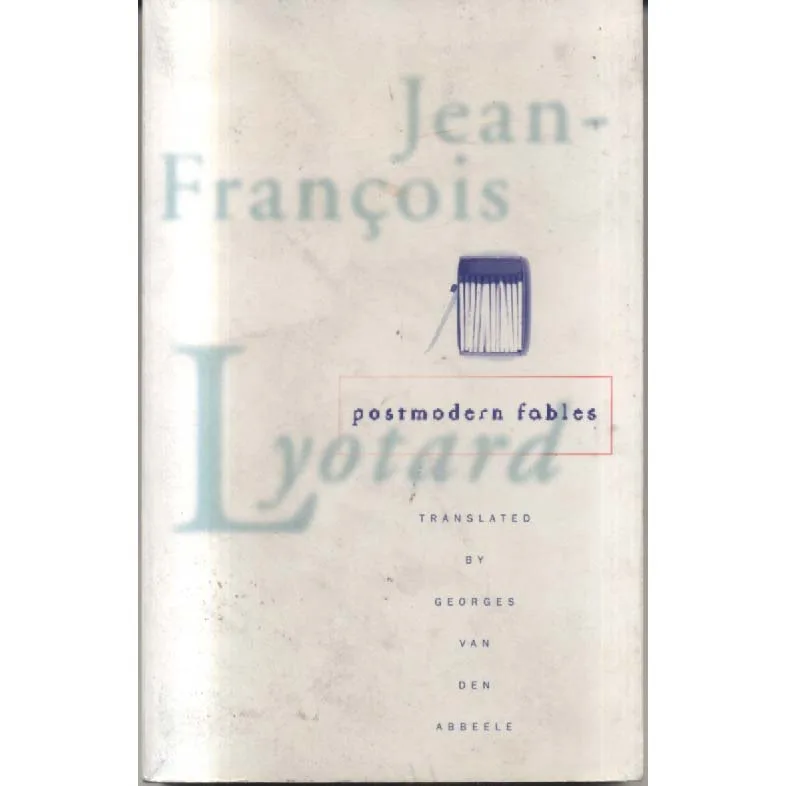
Publisher: University of Minnesota Press
Format: Paperback
ISBN: 9780816625550
Some books politely explain themselves. Postmodern Fables is not especially interested in that sort of vulgar accessibility. Jean-François Lyotard, published here by the University of Minnesota Press in 2003, offers the reader that rare and increasingly endangered experience: a serious intellectual work that expects you to meet it halfway, possibly while frowning slightly and wondering whether modernity was, in retrospect, a terrible administrative overreach.
Lyotard, of course, is one of the great names of postmodern thought, which means he has spent a good deal of time being cited, debated, misunderstood, revered, caricatured and blamed for things he almost certainly did not do. His name tends to hover over conversations about knowledge, culture, technology, legitimacy, language and the collapse of grand explanatory systems, usually in tones suggesting that everyone involved has either read him very carefully or not at all. Postmodern Fables belongs squarely in that world: the world of ideas under pressure, stories about knowledge, and the uneasy suspicion that the modern world has been narrating itself rather too confidently.
The title is marvellous. Postmodern Fables sounds at once ancient and theoretical, as if Aesop had been reassigned to a late twentieth-century seminar on systems theory. A fable is meant to teach, to simplify, to moralise through story. Add postmodern, however, and suddenly the whole enterprise becomes suspicious, self-aware, and faintly amused by its own impossibility. Can one even have a fable once the authority of tidy moral endings has dissolved into competing language games and fractured legitimacies? Lyotard, being Lyotard, is exactly the sort of thinker to ask that question and then answer it in a way that leaves everyone reaching for a pencil.
What makes books like this rewarding is that they are not merely about one subject. They are about the way subjects are constituted, narrated and authorised in the first place. Lyotard is deeply interested in how knowledge works, who gets to validate it, and what happens when the old legitimising narratives lose their grip. That may sound abstract, but it has the rather inconvenient habit of turning out to matter everywhere: in science, politics, education, art, media, and the entire modern tendency to pretend that information arrives free of power or framing. In other words, this is one of those books that appears theoretical until you realise it is quietly sawing at the floorboards of contemporary life.
There is, naturally, a wonderful irony in a book called Postmodern Fables becoming itself a sturdy university-press paperback: catalogued, assigned, shelved, underlined, perhaps quoted in essays by students alternating between enlightenment and despair. The postmodern condition may have complicated the status of knowledge, but the library system marches on regardless. Somewhere, one imagines, a reader opened this book in sincere hope of quickly finding out what postmodernism is, only to discover that the answer was: not quickly.
The University of Minnesota Press is exactly the right publisher for such a work. They have long specialised in books that combine seriousness, theoretical ambition and the quiet promise that you may emerge from them either transformed or slightly cross. This is not airport reading. It is not even train reading unless the train is travelling toward a colloquium. It is, however, exactly the sort of book that keeps intellectual life interesting by refusing to let easy certainties settle too comfortably.
This Good copy, sold by Crappy Old Books, has the honourable feel of a volume that has probably spent time among earnest shelves and serious intentions. Perhaps it belonged to a philosophy student, a cultural theorist, an artist with strong opinions about discourse, or simply someone who liked their books to contain the occasional challenge. A good copy of Lyotard feels right: presentable, readable, and still fully capable of destabilising a casual assumption or two.
A fine find for readers of philosophy, critical theory, postmodern thought, and the broader literature of ideas behaving badly, Postmodern Fables is a book for anyone who enjoys asking awkward questions about knowledge, truth, narrative and the modern world’s favourite self-justifications. Dense? At times, certainly. Important? Very probably. Cheerfully compliant? Not for a second. Which, in a thinker like Lyotard, is rather the point.
Keep browsing: See more Non-Fiction books Other books by Jean-Francois Lyotard
